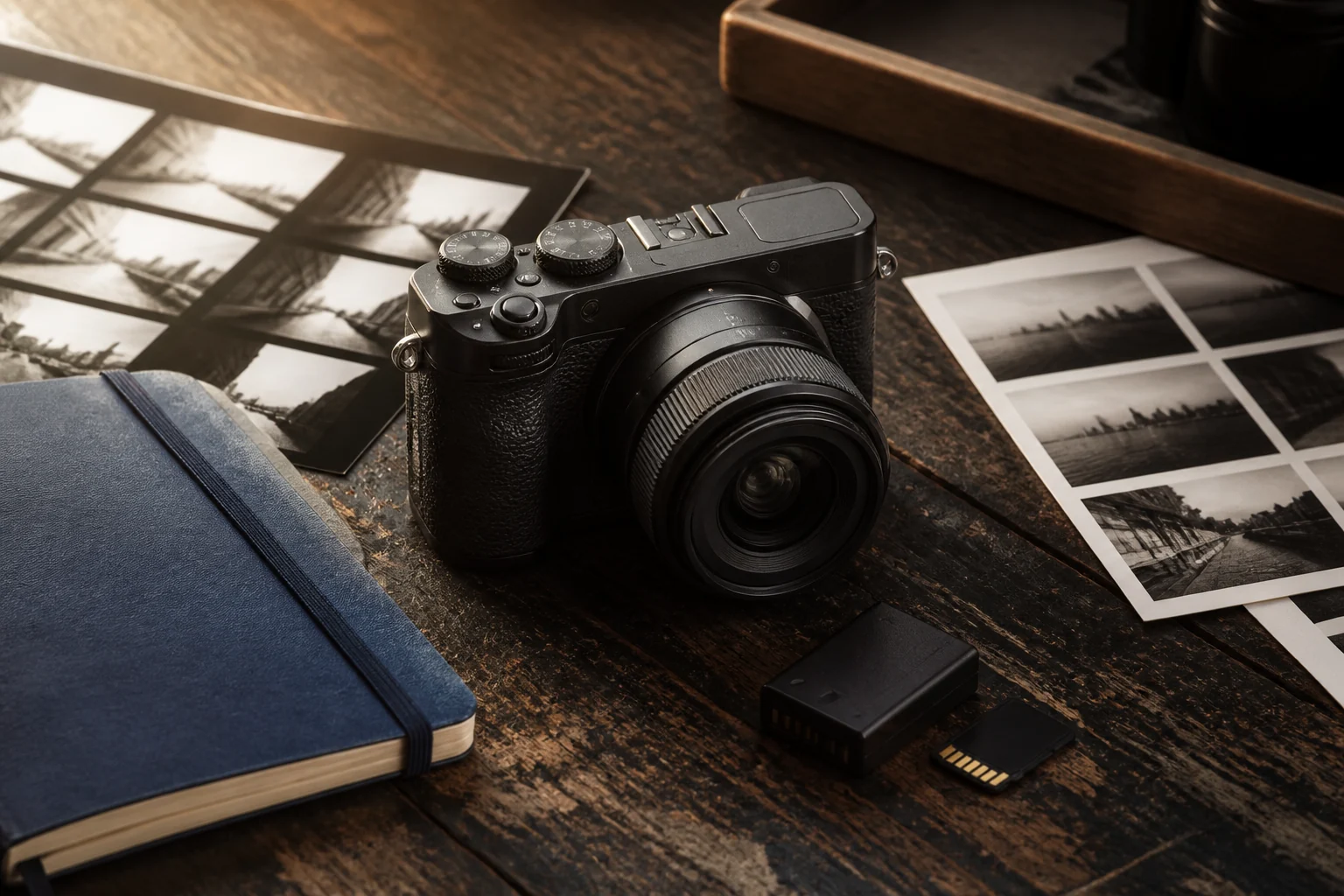
The best camera for beginners is not necessarily the body with the longest specification sheet. It is the camera that makes it easy to get a sharp photograph today, learn exposure and composition tomorrow, and add the right lens when your interests become clearer.
For most new photographers, that camera is the Canon EOS R50. Its autofocus, approachable touchscreen interface, small body, and useful kit-lens options remove friction without closing off manual control. The Nikon Z50II is the stronger long-term choice for a beginner who already expects photography to become a serious hobby, while the Fujifilm X-T30 III is the most appealing option for people who value compact size, tactile controls, and polished JPEG color.
This guide also includes a genuinely inexpensive entry point, two distinctive everyday-carry cameras, and a mature Sony option that can be especially attractive used.
Quick comparison of the best cameras and camera gear
| Camera | Best for | Key facts and main compromise |
|---|---|---|
| Canon EOS R50 | Most beginners | 24.2MP APS-C; 13.2 oz / 375 g; RF/RF-S mount; no in-body stabilization |
| Nikon Z50II | Long-term growth | 20.9MP APS-C; 17.5 oz / 495 g; Nikon Z mount; short rated battery life |
| Fujifilm X-T30 III | Color and compact controls | 26.1MP APS-C; 13.3 oz / 378 g; Fujifilm X mount; no in-body stabilization |
| Canon EOS R100 | Lowest new-kit cost | 24.1MP APS-C; 12.6 oz / 356 g; RF/RF-S mount; fixed non-touch screen |
| Nikon Z fc | Learning with physical dials | 20.9MP APS-C; 13.8 oz / 390 g; Nikon Z mount; shallow grip and older autofocus |
| Ricoh GR IIIx | Pocketable street and travel camera | 24.2MP APS-C; 9.2 oz / 262 g; fixed 40mm-equivalent lens with no zoom |
| Sony a6400 | Used value and lens choice | 24.2MP APS-C; 14.3 oz / 403 g; Sony E mount; older interface and battery |
Weights and core specifications come from the manufacturers’ U.S. support or product pages. A lower weight does not automatically mean a more portable kit: the attached lens often changes the result more than the camera body.
Selection criteria for the best beginner camera
Ease of use without a low ceiling
A good beginner camera needs a dependable automatic mode, understandable menus, and autofocus that can recognize common subjects. It should also expose aperture, shutter speed, ISO, focus mode, and exposure compensation once you are ready to take control. A camera that hides every decision can become limiting; one that demands expert setup can stay at home.
Price and total system value
The body is only part of the cost. A realistic first-camera budget includes a lens, memory card, spare battery, and protective bag. Interchangeable-lens buyers should also look at the price of the next lens they are likely to want. An inexpensive body attached to an expensive or narrow lens system may cost more over three years than a slightly pricier kit.
Lens ecosystem and upgrade path
Canon RF, Nikon Z, Fujifilm X, and Sony E all offer a path beyond the starter zoom. Sony and Fujifilm have particularly broad APS-C selections, while Canon and Nikon let beginners move into their full-frame systems without abandoning the mount. Canon EF/EF-S and Nikon F lenses can also be adapted with first-party adapters, although an adapted kit is larger.
Sensor size and image needs
Every pick here uses an APS-C sensor, including the fixed-lens Ricoh. APS-C is a useful middle ground: materially larger than a typical phone sensor, smaller and generally less expensive than full frame, and capable of excellent prints and low-light images with the right lens. None of these cameras requires full frame to produce professional-looking photographs.
Autofocus, reliability, and battery life
Modern subject detection makes family, pet, and travel photography easier, but the newest systems generally do it more confidently than older ones. Battery ratings matter too, especially with mirrorless cameras. They are standardized comparison figures rather than a promise of exactly how many pictures you will take, but a 200-shot rating signals a stronger need for a spare battery than a 400-shot rating.
Top 7 best cameras for beginners by use case
Each beginner camera below solves a different problem. The ranking favors approachable controls, dependable autofocus, useful image quality, current support, and a camera gear path that makes sense for U.S. buyers. There is no universal best camera for every subject, so use the “choose it if” line to match a camera to the photographs you actually want to make.
1. Canon EOS R50 — best camera for beginners overall
The Canon EOS R50 is the easiest recommendation for a first interchangeable-lens camera. Canon combines a 24.2-megapixel APS-C sensor and DIGIC X processor with a fully articulating touchscreen, electronic viewfinder, and Dual Pixel CMOS AF II. The body weighs about 13.2 ounces with its battery and card, according to Canon’s detailed specifications.
That combination is useful because it handles the intimidating parts well without preventing experimentation. Subject detection and eye autofocus help with people and pets. The touchscreen feels familiar to a phone user. When you want to learn, the mode dial and on-screen guidance provide access to aperture priority, shutter priority, and full manual exposure.
The common RF-S 18-45mm kit lens is small and covers everyday scenes, groups, and travel. It is not bright enough for every indoor situation, but it is the sensible place to begin. After a few months, your own photos will tell you whether the next purchase should be a brighter prime, a telephoto zoom, or an ultra-wide lens.
Primary advantages
- Strong subject-detection autofocus for family, pet, and travel photography.
- A vari-angle touchscreen that makes low, high, and self-facing compositions easier.
- Compact size and simple controls without giving up RAW capture or manual exposure.
- Access to Canon RF and RF-S lenses, plus many EF and EF-S lenses through Canon’s adapter.
Tradeoffs and limitations
- There is no in-body image stabilization. You must rely on lens stabilization, shutter speed, or a tripod.
- The small body has fewer direct controls than enthusiast cameras.
- Canon’s native RF-S lens range is improving, but buyers should confirm that the specific lens they want exists at an acceptable price.
Choose it if: you want the most forgiving all-around beginner camera for family, trips, portraits, and everyday photography.
2. Nikon Z50II — best APS-C camera for long-term growth
The Nikon Z50II costs and weighs more than the R50, but it gives a committed beginner more room to grow. Nikon pairs a 20.9-megapixel DX-format sensor with its newer EXPEED 7 processor, a deep grip, a 3.2-inch vari-angle touchscreen, and subject detection inherited from more advanced Z cameras.
Its controls feel closer to a small enthusiast camera than an appliance. That is useful if you intend to practice manual exposure, customize buttons, photograph action, or add more capable lenses. Nikon specifies up to 11 frames per second with full-resolution RAW files and up to 30 fps with JPEGs in the appropriate mode. The Z50II also accepts UHS-II SD cards, which can clear bursts faster than the UHS-I cards used by several cheaper bodies.
The body is 17.46 ounces with battery and card. Nikon’s rating of roughly 220 to 250 still images per charge, depending on display and power settings, is the conspicuous weakness. A spare EN-EL25a battery belongs in the budget.
Primary advantages
- Confident modern autofocus and subject recognition.
- A comfortable grip, useful direct controls, and a bright electronic viewfinder.
- Nikon Z mount supports compact DX zooms and a large catalog of full-frame Z lenses.
- Strong stills-and-video feature set for a beginner who wants to develop several skills.
Tradeoffs and limitations
- It is one of the larger, more expensive APS-C bodies in this guide.
- The official battery rating is modest.
- Nikon’s dedicated DX prime-lens selection is smaller than Fujifilm X or Sony E, although compatible full-frame and third-party options broaden the system.
Choose it if: you already know you enjoy photography and would rather buy a body that can support several years of growth.
3. Fujifilm X-T30 III — best compact camera with interchangeable lenses and creative color
Fujifilm’s X-T30 III makes the process of taking pictures feel deliberate without making the camera large. It uses a 26.1-megapixel X-Trans CMOS 4 APS-C sensor and X-Processor 5 in a body that weighs 13.3 ounces with battery and card. Its top plate combines exposure controls with a dedicated Film Simulation dial.
Film Simulations are in-camera color profiles—not replacements for learning light or exposure—but they let a beginner create attractive JPEGs without immediately building an editing workflow. RAW files remain available when you want more latitude. The X-T30 III also provides an electronic viewfinder, subject tracking, 6.2K/30p video, and a rated 425 images per charge under Fujifilm’s stated normal conditions.
Fujifilm’s APS-C-first lens catalog is a major advantage. The compact XC13-33mm kit lens is unusually wide at the short end and weighs only 4.4 ounces, while the system has primes and zooms at many price levels. The body itself lacks in-body image stabilization, so lens choice and technique matter in low light.
Primary advantages
- Excellent compactness for an interchangeable-lens camera with a viewfinder.
- Film Simulations encourage experimentation with color and monochrome JPEGs.
- Deep Fujifilm X lens ecosystem designed around APS-C.
- Physical controls make exposure settings visible and can reinforce learning.
Tradeoffs and limitations
- No in-body stabilization.
- The grip is small, particularly with heavier lenses.
- Beginners focused on fast, erratic subjects may prefer the autofocus behavior and larger grip of the Nikon Z50II or Canon R50.
Choose it if: you want a small camera that makes color, style, and the act of shooting feel central—and you prefer to spend less time editing.
4. Canon EOS R100 — best value camera for beginners
The Canon EOS R100 strips an interchangeable-lens camera down to the essentials. Its 24.1-megapixel APS-C sensor, electronic viewfinder, RF mount, and familiar Canon color make it capable of much better photographs than its entry price might suggest. At roughly 12.6 ounces with battery and card, it is also easy to carry.
The compromises are not subtle. The rear screen is fixed and does not support touch control. The older DIGIC 8 processor and autofocus system are less sophisticated than those in the R50. Its 4K video mode is heavily cropped and not a reason to buy it. Continuous shooting tops out at a relatively modest rate.
Those limits matter less for landscapes, travel details, still life, posed portraits, and learning exposure. If the R100 kit is substantially cheaper than an R50 kit, it can be a rational way to reserve money for a lens, class, or photo trip. If the prices are close, buy the R50.
Primary advantages
- Frequently the least expensive path to a current mirrorless system.
- Good APS-C still-image quality and a built-in electronic viewfinder.
- Small, light body with access to Canon’s RF mount.
- Simple enough for a first-time buyer focused mainly on still photographs.
Tradeoffs and limitations
- Fixed, non-touch rear display.
- Older autofocus and processor than the R50.
- Limited 4K video and fewer controls for growth.
- No in-body stabilization or automatic sensor-cleaning mechanism.
Choose it if: your budget is firm, still photography is the priority, and the kit costs meaningfully less than the R50.
5. Nikon Z fc — compact APS-C camera for learning with tactile dials
The Nikon Z fc is built around visible exposure controls. Separate engraved dials for shutter speed, ISO, and exposure compensation let you see key settings before lifting the camera. That can make the relationship between settings easier to understand than a design that routes everything through menus.
Under the retro shell is a 20.9-megapixel DX sensor, Nikon Z mount, eye-detection autofocus, and vari-angle screen. Nikon lists the body at about 13.8 ounces with battery and card and rates it for approximately 300 photographs per charge. It can shoot 4K/30p video and up to 11 fps at full resolution.
The Z fc predates the Z50II’s newer processor and autofocus system. It also has a shallow grip, which looks elegant with a compact prime or kit zoom but is less comfortable with a heavy telephoto. Its value depends on price: it makes the most sense when its design genuinely motivates you to carry it or when a refurbished kit is attractively priced.
Primary advantages
- Dedicated dials can turn exposure practice into a more intuitive routine.
- Light body, vari-angle display, and electronic viewfinder.
- Nikon Z lens compatibility and access to adapted F-mount lenses.
- Distinctive design that some owners will be more inclined to carry.
Tradeoffs and limitations
- Older autofocus and processing than the Z50II.
- Minimal front grip with larger camera gear.
- No in-body stabilization, and the battery rating is only average.
Choose it if: physical controls help you learn and a camera’s design affects whether you want to take it with you.
6. Ricoh GR IIIx — best pocketable compact camera for beginners
The Ricoh GR IIIx is the outlier. It has no interchangeable lens, no built-in viewfinder, and no zoom. Instead, it combines a 24.2-megapixel APS-C sensor with a fixed 26.1mm f/2.8 lens that frames like a 40mm lens on full frame. The result weighs only 9.2 ounces with battery and card and fits in many jacket pockets.
That fixed-lens simplicity can be educational. You learn to move, anticipate framing, and work within one perspective rather than solving every problem by buying another lens. The 40mm-equivalent view is natural for street scenes, travel details, environmental portraits, food, and daily life. Ricoh also includes sensor-shift stabilization and its Snap Focus distance-setting feature.
The GR IIIx is not inexpensive, and its approximately 200-image battery rating makes a spare battery essential. The lens does not become wider for interiors or longer for distant subjects. Dust ingress has also been a recurring concern around pocket-carried fixed-lens cameras, so use a clean pocket or protective sleeve and follow Ricoh’s care guidance.
Primary advantages
- The smallest complete camera kit in this guide.
- Large APS-C sensor, sharp fixed lens, and built-in stabilization.
- Discreet operation and useful controls for everyday and street photography.
- A one-lens constraint that can sharpen composition skills.
Tradeoffs and limitations
- Fixed focal length: no zoom and no lens upgrade path.
- No built-in viewfinder.
- Short battery rating and premium compact-camera price.
- Not the right first camera for wildlife, field sports, or anyone who wants broad focal-length flexibility.
Choose it if: the camera you want is one you can carry almost every day, and a single normal-angle lens fits your subject matter.
7. Sony a6400 — best mature APS-C camera system and used-market option
The Sony a6400 is older than the other interchangeable-lens bodies here, but it remains relevant because the E-mount ecosystem is so broad. Sony’s official specifications list a 24.2-megapixel APS-C sensor, 425 phase-detection and 425 contrast-detection autofocus points, up to 11 fps shooting, and a weight of 14.3 ounces with battery and card.
Its autofocus remains useful for people, pets, and moving subjects, while Sony, Sigma, Tamron, and other manufacturers offer many APS-C E-mount lenses. New old-stock pricing can be awkward, so the a6400 is often most compelling as a clean used body from a seller with a return period.
Age shows in the interface, small NP-FW50 battery, micro-USB connection, and lack of in-body stabilization. The rear screen tilts rather than articulates to the side. None of those prevents good photographs, but a new Canon R50 can feel friendlier at a similar total price.
Primary advantages
- Proven autofocus and fast burst shooting.
- One of the broadest APS-C lens selections, including many third-party choices.
- Compact body with an electronic viewfinder and tilting screen.
- Potentially strong used value.
Tradeoffs and limitations
- Older menus, micro-USB, and a small battery; Sony rates about 360 shots with the viewfinder or 410 with the LCD.
- No in-body stabilization.
- Used buyers need to check sensor condition, controls, ports, battery health, and return terms.
Choose it if: lens choice and autofocus matter more than having the newest body, especially if you find a well-documented used kit.
How to choose the right camera for a beginner
Choose based on what you want to photograph
- Family, pets, and general travel: Canon EOS R50.
- Action, wildlife learning, and long-term system growth: Nikon Z50II.
- Everyday color and creative JPEGs: Fujifilm X-T30 III.
- Landscapes and still subjects on the lowest budget: Canon EOS R100.
- Exposure practice through physical controls: Nikon Z fc.
- Street, daily life, and light travel: Ricoh GR IIIx.
- A broad affordable lens catalog or a used deal: Sony a6400.
Choose based on sensor size and image needs: APS-C versus other formats
APS-C is not a beginner-only format. It provides plenty of resolution for common print sizes, good subject separation with bright lenses, and smaller telephoto options than full frame. Micro Four Thirds can produce even smaller stabilized kits and remains worth considering, particularly for travel and wildlife. Full frame offers advantages at very high ISO settings and with shallow depth of field, but bodies and lenses generally cost and weigh more. Start with the format that supports the kit you will carry.
Choose based on portability and compact camera needs
A compact camera such as the Ricoh wins only if its fixed lens suits your work. A small interchangeable-lens body can become a large kit as soon as you add a long zoom. Compare the actual body-and-lens combination, then handle it in a store if possible. Check the grip, viewfinder, menu, and whether you can reach the main controls comfortably.
Choose based on budget and total camera gear cost
Start with the kit zoom unless you already understand why a different lens is necessary. Add one reliable SD card and a spare battery. Use the camera for several weeks before buying another lens. When you do add a prime, remember that a 50mm lens on APS-C behaves like a short portrait lens; a 23mm to 35mm APS-C lens gives a more general-purpose field of view.
Used equipment can stretch the budget, but buy from a seller that states condition and accepts returns. Inspect the sensor, lens glass, autofocus, card slot, screen, dials, ports, and battery. Ask for the shutter count when the camera exposes it, but do not treat that number as a complete measure of condition.
Choose based on learning style and controls
Some beginners learn best with the visible dials of the X-T30 III or Z fc. Others want the camera to handle focus and exposure while they learn composition; the R50 is better for that approach. Neither is more legitimate. The best beginner camera is the one that makes practice feel inviting rather than dutiful.
Which option is best for you?
The Canon EOS R50 is the best camera for beginners who want a simple, capable default. The Nikon Z50II is the better camera for a committed beginner photographer who values grip, autofocus, and room to grow. Choose the Fujifilm X-T30 III when compact size and straight-out-of-camera color matter most; the Canon EOS R100 when the lowest complete-kit price is decisive; and the Nikon Z fc when visible exposure dials will help you learn.
The fixed-lens Ricoh GR IIIx is the best compact camera here for daily-carry street and travel work, but only if its single focal length suits you. A clean used Sony a6400 remains a persuasive interchangeable lens camera when you want extensive lens choice and strong autofocus for the money.
Camera gear to buy with your first camera
Keep the first setup simple:
- The kit lens. It establishes which focal lengths you actually use.
- One correctly rated SD card. Follow the camera manual, especially for high-bitrate video or long bursts.
- One genuine or reputable spare battery. This is particularly important for the Ricoh GR IIIx and Nikon Z50II.
- A small padded camera bag. It should fit the assembled camera without forcing you to build an oversized kit.
- A blower and clean microfiber cloth. Avoid touching the sensor or using improvised cleaning fluids.
- A lightweight tripod only if your subjects need it. It is valuable for night scenes, self-portraits, landscapes, and deliberate exposure practice—not mandatory for everyone.
If your first camera will spend time on trails, use our camera bags for hiking guide to compare load transfer, access, weather protection, and space for non-camera essentials.
Frequently asked questions
DSLR vs. mirrorless camera for beginners: which is easier to learn?
A mirrorless camera is usually the best camera for photography beginners buying new in 2026. Its electronic viewfinder can preview exposure, white balance, and depth-of-field changes before you press the shutter, while subject-detection autofocus reduces the effort required to keep a person or animal sharp. Current entry-level cameras, lenses, and firmware development also concentrate on mirrorless systems.
A DSLR uses an optical viewfinder, typically offers excellent battery life, and can be inexpensive on the used market. It teaches the same aperture, shutter-speed, ISO, focus, and composition skills. The tradeoff is that major manufacturers have shifted their newest camera gear toward mirrorless mounts. A used DSLR is therefore best treated as an affordable complete kit; a mirrorless camera for beginners provides the clearer long-term upgrade path.
Is a DSLR or mirrorless camera better for a beginner in 2026?
Mirrorless is the safer new purchase for most people because current development, autofocus systems, and lens releases concentrate there. A used DSLR can still be an excellent learning tool if the price is low and the body and lens are in good condition. Judge it as a complete, finite kit rather than assuming every old mount will receive future products.
How many megapixels does a beginner need?
The 20.9 to 26.1 megapixels offered here are enough for detailed prints and moderate cropping. Lens quality, focus, shutter speed, light, and composition have a larger effect on most beginner results than a small difference in pixel count.
Should a first camera have in-body image stabilization?
It is helpful, not essential. Stabilization reduces blur from camera movement at slower shutter speeds; it does not freeze a moving child, athlete, or animal. Several lenses include optical stabilization, and good technique or a tripod can solve many static-subject situations.
What is the single best camera for photography beginners?
For most U.S. buyers, the Canon EOS R50 offers the best balance of approachable operation, autofocus, image quality, size, and price. Choose the Nikon Z50II if you want a more substantial body and greater growth headroom, or the Fujifilm X-T30 III if compact controls and in-camera color are what will make you shoot more often.
Final thoughts for beginner photographers
Buy the Canon EOS R50 if you want a clear default. Buy the Nikon Z50II if you are comfortable paying more for a stronger long-term body. Buy the Fujifilm X-T30 III if its size, dials, and Film Simulations make photography feel more appealing.
Then stop comparing cameras for a while. Take one subject, one neighborhood, or one family routine and photograph it repeatedly. Regular practice will improve your pictures more than replacing a capable APS-C camera with the next specification upgrade.